April 1, 2026
Intake Automation in Equipment Finance: Faster Doesn't Mean Better
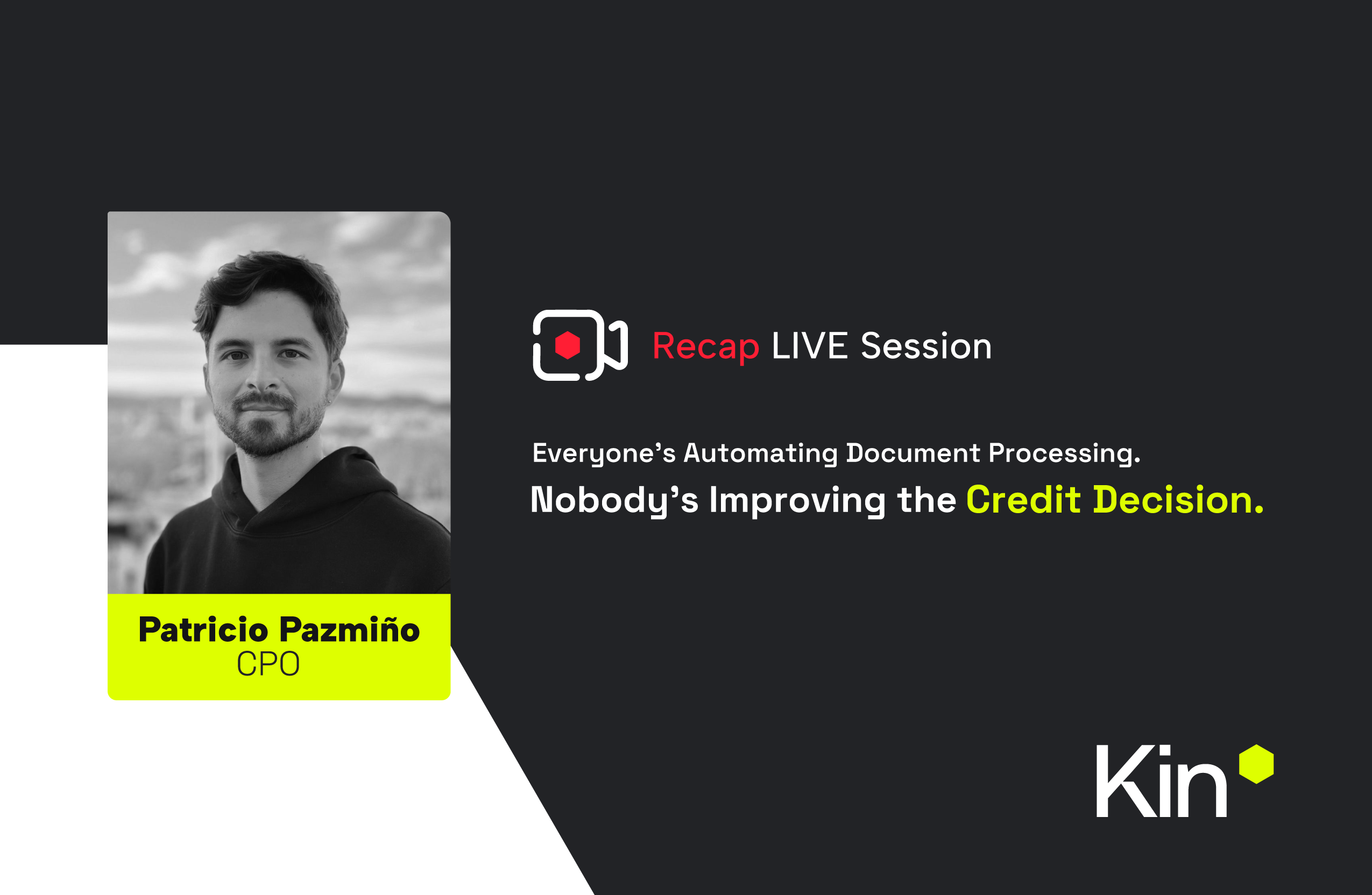
Does automating your intake process actually improve the credit decision?
The short answer: not on its own. Faster intake makes a flawed credit decision arrive sooner — it doesn't make it more accurate. And that gap between automating a process and improving an outcome is exactly where most equipment finance lenders are losing ground without realizing it.
Across two years of discovery work with dozens of lenders and partners, the same pattern keeps showing up: intake automation projects that hit their processing-time targets but never measure whether the credit decision actually got better. The bottleneck moves. The risk doesn't.
This piece walks through why intake is a credit risk problem (not an operations one), what generic SaaS tools miss in equipment finance, and the three principles that separate working deployments from the ones that stall after the pilot — including a live AI demo Kin built on screen in under two minutes and the real numbers from a US mid-market lender deployment.
Why Is Intake a Credit Risk Problem, Not an Operations Problem?
Most intake automation projects optimize processing time and call it a day, never measuring whether the credit decision actually got better. But intake is not a back-office efficiency challenge with a side effect on risk. It is the front door to the credit decision.
Four root causes drive intake failure in equipment finance, and all four live upstream of credit:
- Manual rekeying. Teams spend 30 to 60 minutes per deal typing field by field from email attachments, with errors that compound downstream.
- Format inconsistency. Scanned PDFs, handwritten broker forms, portal uploads, faxes — multiple channels, no standardization, no structure reaching the credit analyst.
- Missing information. Without upfront validation, incomplete applications pass straight through to credit. The work does not disappear. It accumulates.
- Conflicting sources. Mismatched addresses, name variations, and ID discrepancies affect bureau lookups and decision confidence in ways that are hard to trace back to intake.
Every one of these is a data quality problem, not a processing speed problem. Applying AI to any of them without fixing the underlying structure first does not reduce credit risk it accelerates it.
What Happens When You Automate Bad Data?
This was the sharpest line from Kin's recent live session, and the one worth repeating most:
"Speed without data integrity is just a risk amplifier. Automating bad data means making wrong decisions faster."
— Patricio Pazmino, CPO, Kin Analytics
The test is simple. If your automation project has no metric for credit quality movement, it is not solving the problem you think it is solving. Moving the bottleneck downstream from intake to the analyst's desk, or from the analyst's desk to funding, and calling that automation is not a win.
Validation belongs at the front door, not three steps later.
What Do Generic SaaS Tools Miss in Equipment Finance Intake?
The AI intake automation vendor pitch is familiar: fast implementation, improving accuracy, measurable ROI. For 60 to 70% of applications — the ones that arrive clean — it often delivers.
The problem is the other 30 to 40%.
In equipment finance, complex collateral, multi-entity guarantors, and handwritten broker submissions are not edge cases. They are normal business. Generic plug-and-play tools are designed for the happy path. Equipment finance does not run on the happy path.
There is a shift underway that changes the calculus. Before AI, lenders chose between expensive custom development and affordable but generic SaaS. That trade-off is dissolving. Custom technology can now be built to the exact specifications of your operation at comparable cost and speed to off-the-shelf solutions.
The technology layer is no longer the hard part. The hard part is knowing your business well enough to build the right thing.
How Fast Can AI Turn an Inbox Into CRM-Ready Data? (Live Demo)
To move from argument to evidence, Patricio built a working intake automation tool live on screen — no pre-built code, three prompts.
Step 01 — Inbox scan
The AI scanned a Gmail inbox, identified the credit application email, and uploaded all three attachments to Google Drive automatically.
Step 02 — OCR + extraction
All three documents — including a handwritten broker form — were read and parsed: applicant details, asset information (make, model, year, mileage, VIN), and guarantor data. Accuracy above 97%.
Step 03 — Structured output
Data reorganized into CRM-ready objects — applicant, business, asset — ready to paste or sync directly. Inbox to structured record in under two minutes.
The demo was intentionally transparent about its limits. This was not a production-ready system. The point was to show how low the technology barrier has become — and why competitive advantage now belongs to the teams who understand their own workflows well enough to build the right solution, not the teams who simply buy the most expensive one.
What Separates a Working Intake Automation Deployment From One That Stalls?
Based on Kin's work implementing intake automation across multiple equipment finance lenders, three principles consistently separate successful deployments from the ones that stall after the pilot.
- Forward deploy. Do not observe the workflow from a distance. Put someone in the seat. Your team should physically run the process, feel the friction, and find where the real problems are. You can only build the right solution from the inside.
- Flexible toolkit. Do not anchor your implementation to a single AI model. The landscape evolves weekly. Build model-agnostic so you can swap in better components as they emerge without rebuilding the entire system.
- Metrics first. Define your target metric before writing a line of code. Processing time, error rate, volume capacity — know your baseline on day one. Do not stop until the metric moves.
The knowledge gap — not the technology — is what fails most implementations.
What Do Real-World Intake Automation Results Look Like?
A US mid-market equipment finance lender was processing 2,000 applications per month and had hit a capacity ceiling. More headcount was not the answer.
Kin's team forward-deployed — two members joined intake operations and physically ran the workflow, completing four production-grade iterations within weeks. The operations team migrated organically as the tool improved.
After five months:
- 70% reduction in processing time, from 30 minutes to 7 minutes per application
- +4% volume growth with the same team
- $250K+ in projected annual savings
- No new headcount. No replaced systems.
Faster Is Not Better If the Data Is Wrong
The equipment finance industry does not have a speed problem. It has a data quality problem that gets misread as a speed problem — and automation is being applied to the symptom, not the cause.
The lenders who will pull ahead are the ones who treat intake automation as a credit risk strategy, not an operations efficiency play. Who measure credit quality improvement, not just processing time. Who build from the inside out, with the knowledge of their own business as the real moat.
Technology is no longer the barrier. The question is whether you are using it to solve the right problem.
When you evaluate your next automation investment, ask yourself: are you solving for faster or are you solving for better?
Download the Full Webinar Recap
Frequently Asked Questions
Does automating intake automatically improve credit decisions in equipment finance?
No. Automation speeds up whatever process you already have. If the underlying data is incomplete, inconsistent, or unvalidated, automation simply pushes those problems to the credit analyst faster. Improving the credit decision requires fixing data quality at the front door — not accelerating the existing workflow.
What are the most common bottlenecks in equipment finance intake?
Four root causes drive intake failure: manual rekeying (30–60 minutes per deal); format inconsistency across PDFs, broker forms, portals and faxes; missing information that passes through to credit without validation; and conflicting data sources that affect bureau lookups and decision confidence.
Why don't generic SaaS intake tools work for equipment finance?
Generic tools handle the 60–70% of applications that arrive clean. They struggle with the other 30–40% — complex collateral, multi-entity guarantors, handwritten broker submissions — which are not edge cases in equipment finance. They are normal business.
What metrics should equipment finance lenders track when implementing intake automation?
Define the target metric before writing a line of code. Processing time, error rate, and volume capacity are the baseline three. Critically, also measure credit quality movement — if your automation project has no metric for whether credit decisions improved, it's solving for speed, not risk.
What kind of results are realistic for intake automation in equipment finance?
A US mid-market lender Kin worked with reduced processing time by 70% (from 30 minutes to 7 minutes per application), grew volume 4% with the same headcount, and projected $250K+ in annual savings — over a five-month implementation, with no replaced systems and no new hires.
Should equipment finance lenders build or buy intake automation?
The traditional trade-off — expensive custom build vs. affordable but generic SaaS — is dissolving. Custom technology can now be built to the exact specifications of your operation at comparable cost and speed to off-the-shelf solutions. The hard part is no longer the technology. It's knowing your business well enough to build the right thing.
/Like this post?



.jpg)
.webp)